
FAQs for 1979 Mission Street
Para ver las preguntas frecuentes en español, haga clic aquí.
Project Overview
What is this project?
La Maravilla, also known as The Marvel in the Mission or 1979 Mission Street, is an affordable housing development rooted in decades of community advocacy to fight displacement and preserve the culture of the Mission District. The proposed project aims to create over 300 new homes—split between Multifamily Affordable Housing and Permanent Supportive Housing (PSH)—to serve low-income families and individuals experiencing or at risk of homelessness.
In August 2023, the Mayor’s Office of Housing and Community Development (MOHCD) released a Request for Qualifications (RFQ) to select experienced developers to bring this long-awaited vision to life. La Maravilla represents a major step forward in providing deeply affordable housing in a neighborhood historically impacted by gentrification and rising housing costs.
Who are the project developers?
In December 2023, the “Mayor’s Office of Housing and Community Development (MOHCD) announced the selection of Mission Economic Development Agency (MEDA) and Mission Housing Development Corporation (Mission Housing) to lead development of new permanently affordable rental housing at 1979 Mission Street.”
Both organizations are experienced affordable housing developers with long histories of serving the Mission District. Mission Housing brings over 50 years of affordable housing development expertise, while MEDA is a developer that pairs construction with a holistic service model. By integrating wrap-around support for economic mobility, they ensure that the housing provides not just a roof, but a foundation for the long-term success and financial stability of its residents.
What is the timeline for construction and completion?
La Maravilla is planned to be constructed in three phases. The first phase will consist of the Permanent Supportive Housing (PSH) building and is set to start construction in December 2025. The second phase will be the first Multifamily Affordable Housing (Family building) building on Mission Street and is aiming to begin construction in July 2027, depending on funding. The third phase will be the second Multifamily Affordable Housing (Family building) building on Capp Street and is aiming to start construction in July 2028, depending on funding. Please see below schedule overview for each of the three buildings:
Phase 1PSH Building | 16th Street, Midrise
Estimated Demolition of the existing building and construction start: December 2025
Construction duration 23 months - until November 2027
Lease up to begin late Fall 2027
Phase 2: Family Building | Mission Street, High-rise
Estimated construction start: July 2028
Construction duration 30 months - until December 2030
Lease up to begin late Fall 2030
Full occupancy Spring of 2031
Phase 3: Family Building | Capp Street, Midrise
Estimated construction start: July 2029
Construction duration 24 months - until July 2031
Lease up to begin Spring 2031
Full occupancy by Fall of 2031
Why is the PSH building being constructed first, and when will the family buildings be built?
La Maravilla is designed as a multi-building, affordable community, and Permanent Supportive Housing (PSH) is an essential part of that vision. PSH provides stable homes and on-site services for residents who have experienced chronic homelessness.
The PSH building is going first because its funding aligned first — not because anyone is being prioritized over anyone else. PSH has access to certain state and local funding streams that became available sooner. The family buildings rely on different, highly competitive sources that follow their own timelines. This is typical for multi-phase affordable housing projects.
The Mayor’s Office of Housing and Community Development (MOHCD) issued a Request for Qualifications (RFQ) for this site, and it specifically required a mix of PSH units and affordable family units. Developers did not have the option to choose one or the other. From day one, the City’s direction was clear: this site must serve both families and residents exiting homelessness.
Additionally, for years, the Plaza 16 Coalition led a neighborhood-wide campaign demanding that this site include affordable family housing and PSH. The advocacy effort that shaped La Maravilla always envisioned PSH as a core part of serving the most vulnerable neighbors.
Affordable homes for families address displacement and overcrowding. PSH provides stable housing and on-site services for people who have experienced chronic homelessness. Both are essential to a safer, healthier neighborhood, and both reflect the values of local residents and organizations who organized and advocated for this project.
The development team is committed to ensuring that both families and PSH residents feel welcomed, supported, and connected to the neighborhood.
How will the project be funded?
Affordable housing units are funded by a combination of local, state, and federal affordable housing financing sources, as well as bond proceeds. State financing sources are highly competitive because funds are distributed across the entire state, and numerous projects compete for financing every year.
Below are the assumed sources of funds for each phase:
Phase 1 - PSH
MOHCD (committed)
No Place Like Home (committed)
Restore-Rebuild
LIHTC (committed)
Tax-Exempt Bonds (committed)
Phase 2 - FAM
MOHCD (Uncommitted)
LIHTC (Uncommitted)
Tax-Exempt Bonds (Uncommitted)
AHSC (Uncommitted)
Phase 3 - FAM
MOHCD (Uncommitted)
LIHTC (Uncommitted)
Tax-Exempt Bonds (Uncommitted)
AHSC (Uncommitted)
Housing Details
What are the AMI levels?
Phase 1 - PSH | 16th Street
Subsidized units will pay 30% of the tenant’s income
Rents range from: 30% to 50% of the AMI
Phase 2 - FAM | Mission Street
Phase 3 - FAM | Capp Street
The AMI levels for the Family Phases are still being worked out. However, for funding requirements, both buildings will need an average AMI of 50% or below.
AMI levels would typically range between 30% and 80% of the AMI.
MEDA’s and MHDC’s goal is to maximize affordability as much as possible.
How many units will there be?
All of the unit counts for each phase of this project at proposed and subject to change as the project is finalized and funding is secured.
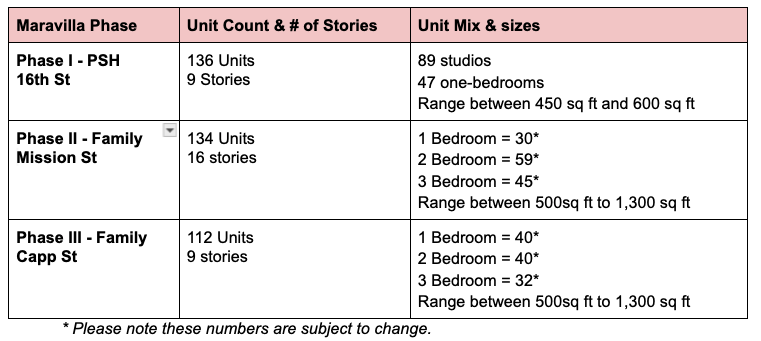
For Phase 1: Permanent Supportive Housing on 16th Street will consist of 136 units.*
For Phase 2: Family Housing on Mission Street will consist of 134 units.*
For Phase 3: Family Housing on Capp Street will consist of 112 units.*
What sizes and types of units would be available (e.g., studios, 1BR, 2BR)?
Will any units be ADA accessible or set aside for seniors, veterans, etc.?
Yes, each building will have the required amount of ADA units.One building is set aside for formerly homeless and the other two builds are set aside for Families.
Why are there 1-bed units in the family buildings?
It is crucial to offer one-bedroom units within the Family Buildings to accommodate the diverse structures of families, thereby providing access for both growing families and smaller households in the Mission District.
Why is there still a 16-story building?
In order to address the housing crisis in San Francisco, particularly the Mission District, the Mayor’s Office of Housing and Community Development (MOHCD) mandated the site to maximize the number of affordable Family Housing units near transit. Furthermore, development costs become more economically viable as the building’s height goes beyond (9) stories. Given the high need not only for affordable housing, but also family size units, this building had to increase height as much as financially feasible.
Will there be parking?
Parking will not be available at La Maravilla. Fortunately, La Maravilla is in a transit-rich area and scores 100/100 on Walk Score, meaning residents will have access to BART and Muni for daily errands and activities. The project also has access to nearby bike networks for active transportation.
Eligibility & Application
Who can apply to live here?
Each building will have varying income restrictions and potential priority preferences based on funding source requirements.
PSH | Phase 1
Residents for the Permanent Supportive Housing (PSH) building will be referred through San Francisco’s Coordinated Entry system, which is run by the Department of Homelessness and Supportive Housing (HSH). Coordinated Entry is the City’s standardized process for identifying and prioritizing people experiencing homelessness who need supportive housing. Once placed, residents sign a lease like any renter, and they also receive case management and other support services to help them thrive in their new home.
FAMILY HOUSING | Phase 2 and 3
All family units will be leased through a public lottery administered by the City. Anyone who meets the qualifications set forth by the lottery process can apply to the Family Housing Units.
Lottery Process: Pre-applications are collected through the City and County of San Francisco's Mayor's Office of Housing's Database of Affordable Housing Listings, Information, and Applications (DAHLIA) system. All applicants who submit complete pre-applications are included in a public electronic lottery. The electronic lottery results are then filtered by any city-sponsored housing or project-specific preferences, and the final results of the filtered lottery are used to fill vacant units in lottery rank order.
Qualification Process: Income eligibility consists of Management's review of income-related documents provided by applicant(s) and documents obtained via Management's 3rd Party Verification. Applicants complete a packet of required forms documenting sources and amounts of current and anticipated income, provide copies of documents (paystubs, taxes, bank statements, award letters, etc.) to support the sources and amounts of current and anticipated income, and a release for Management to verify the sources and amounts of current and anticipated income. After Management's review of documents provided by applicants and 3rd Party Verifications, a calculation test is performed to determine if the household income meets the income restrictions of the property or unit.
Waitlist Management: After applicants are processed in lottery rank order for vacant units, a remaining quantity of usually 500 will become the property's waiting list (in lottery rank order) to fill future vacancies. Management will usually reach out to each of the applicants on the waiting list at least once per year to ensure continued interest in the property and the most up-to-date information (contact and income-related) is known for the selection of future vacancies.
What are the income requirements?
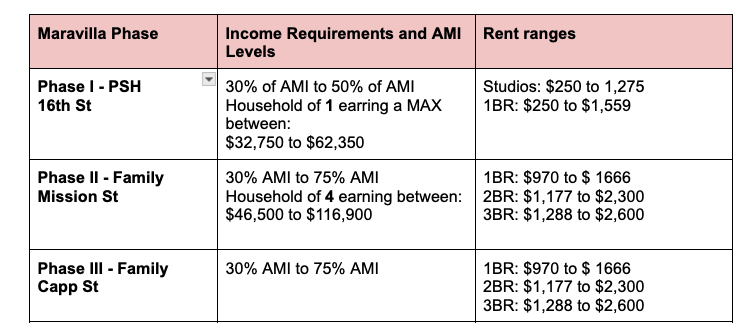
PSH - No minimum income requirements for this building, as tenants will pay 30% of their income towards rent for the majority of the units.
How and when can people apply?
FAM
The affordable family units that will be located on Mission Street & Capp Street will be listed on the DAHLIA website (housing.sfgov.org) for the leasing lottery 3 to 4 months before building completion (September 2029 for Phase 2 on Mission Street, and April 2030 for Phase 3 on Capp Street). If you would like to apply to live at the Family units that will be located on Mission Street and Capp Street, or any other City Affordable Housing, please visit the Mayor's Office of Housing and Community Development's DAHLIA San Francisco Housing Portal.
Affordability
How is "affordable housing" defined in this project?
Funding eligibility typically requires an average of 50% of the Area Median Income (AMI) across a specific project's total units. Nonetheless, the specific AMI thresholds for each property will be determined by the team, contingent upon the competitiveness of various funding sources and the stipulations of lending institutions.
For any specific unit, the applicant must meet the AMI level assigned to the unit, and their rent must be no more than 30% of their annual income. This makes every unit affordable for the qualifying applicant.
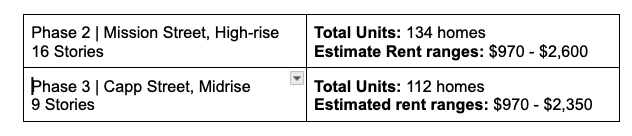
What will the rents be?
Please note that rents are subject to change due to financing and yearly AMI adjustments.
PSH
As a Permanent Supportive Housing building for homeless individuals, AMI levels will be set for very low incomes (20%-50%), and tenants are expected to pay no more than 30% of any income they have. This can range from $0 to $1,559 at the highest.
For the Family Housing: Please note that rents range based on AMI level of each unit, maximum household incomes to qualify for the units, and tenants will be expected to pay no more than 30% of any income they have.
Will rent change over time?
Rental rates are subject to periodic adjustments, which are reflective of updates to the Area Median Incomes as published by the City of San Francisco. Tenants will be duly notified of any modifications by the property management. Certain restrictions and covenants are in place to ensure the housing's ongoing eligibility as affordable housing.
Community Engagement
How has the community been involved in the planning process?
The development team has worked closely with community stakeholders to capture the voice and needs of the community. La Maravilla would not be a possibility without community involvement and the project team plans to incorporate their feedback at key open-decision points for the development.
Will there be ongoing opportunities for community input?
Yes, the project team will present open decision points regarding Family Housing and progress on the development of the project, including PSH, at upcoming Community Meetings. To remain informed, please follow the project on Instagram @1979missionsf and visit the website at www.1979missionsf.com.
How can neighbors & community members stay informed or get involved?
Neighbors & community members can stay informed by following the project on Instagram @1979missionsf and visiting the website at www.1979missionsf.com. Additionally, if there are any questions, they can reach out to our project’s email: info@1979missionsf.com
Community Impact
How will this project benefit the neighborhood?
La Maravilla project proposes the development of approximately 350 affordable housing units within the Mission District. Furthermore, the Family Housing initiative on Mission Street will incorporate a commercial space designated for a local community organization. Similarly, the Family Housing initiative on Capp Street will feature a newly established Early Childcare Center, thereby expanding childcare resources within the neighborhood. The Permanent Supportive Housing component will collaborate with municipal authorities to provide housing solutions for individuals experiencing homelessness and to facilitate access to support services. It is anticipated that these new developments and establishments will enhance the streetscape of the area and contribute to the revitalization of the 16th St. Mission BART Plaza.
What services or amenities will be included for residents?
Each building will offer the following services and amenities: a Residential Services team, in-building laundry facilities, access to courtyard space, and community rooms located within each building.
For the PSH, there will be on-site clinical and medical services using a wrap-around approach for the residents of the building.
For the Family Housing on Mission Street, there will be commercial space designated for a local community organization.
For the Family Housing on Mission Street, there will be a newly established Early Childcare Center, thereby expanding childcare resources within the neighborhood.
Will the project provide open space or community facilities?
Residents and authorized guests will have exclusive access to the courtyards of each building within La Maravilla, mirroring the restricted access to the on-site community rooms. The commercial space located at the Mission Street building, as well as the Early Childcare Center located at Capp Street, will be open to the public. All other amenities and services provided on the premises will be reserved exclusively for the residents of the buildings.
Plaza & Neighborhood
Will this project reduce public access to the BART plaza?
The current site proposal maintains public access to the BART station and seeks to enhance pedestrian safety and flow around the Plaza.
What will happen with the businesses currently located on the 16th Street side of the site?
Business Relocation
Following engagement efforts beginning in late 2024 regarding relocation or compensation, the businesses have elected to accept the in-lieu fee.
Design, Demolition, and Construction
Design
For the Permanent Supportive Housing (PSH) building, the team engaged the AICD for input regarding the window guard design, building colors, and sources of design inspiration. The design team is currently working on incorporating this feedback and will report back by Q1 2026.
For the Family Housing on Mission Street and Capp Street, as of May 2025, there are still a few open decision points regarding:
Look & Feel: To gather feedback from the community regarding the landscaping of the courtyard, the streetscape (BART edges, trees, lighting, etc), and articulation (windows, etc), and materials.
Programming: To gather feedback from the community regarding the commercial space and placekeeping (public art, etc).
Progress on these open decision points will be presented through Community Meetings and Stakeholder Conversations. These meetings will need to be scheduled.
Demolition & Construction
The demolition of the current structure where the Permanent Supportive Housing will be built is scheduled to commence in December 2025. Leading up to this, the development team held community meetings and engaged in stakeholder discussions to ensure that residents and community members are adequately informed and prepared for the upcoming site work. Please consult this resource for updated details.
Safety & Management
Who will manage the property?
John Stewart Company
What safety and security measures will be in place?
Design with resident and neighborhood safety in mind.
No recesses and alcoves in the building facade to avoid undesired/unsupervised activities
To protect our school neighbors the project team and the District 9 office has been actively advocating for additional community ambassador presence in the school perimeter. As of 11/14, a police officer has been stationed at the school during school hours.